

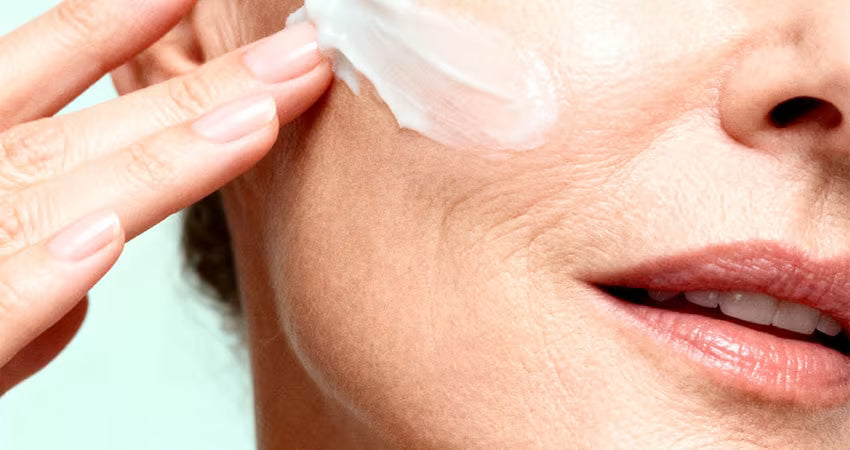
For a long time, sagging has been associated almost exclusively with age. A specific moment when the face or body begins to “drop,” as if it were a visible and inevitable turning point.
Today we know that this reading is incomplete.
The loss of firmness does not appear suddenly, nor does it begin when the skin already shows obvious signs of aging. It starts much earlier, silently, when the skin is still perceived as young, firm, and uniform on the surface.
Understanding when and how this process begins completely changes the way we approach skincare.
Firmness is not lost all at once: it weakens little by little
Skin sagging is not a one-time event, but a progressive process that begins at a structural level.
From early adulthood, the natural mechanisms of skin renewal begin to slow down. Collagen is reorganized less efficiently, elastin fibers lose cohesion, and the skin's internal architecture begins to weaken, even when no change is visible externally.
That is why firmness is not just a matter of what we see, but of how the skin is supported from within.
Invisible sagging: when the skin doesn't show it yet
One of the reasons why sagging is often detected late is that its early stages are not obvious.
In this initial stage, the skin may:
-
feel less dense to the touch
-
recover its shape more slowly after movement
- lose part of its natural elasticity
These are subtle signs, easy to overlook, but they indicate that the skin is beginning to lose its support capacity.
By the time sagging becomes visible, this process has usually been developing for some time.
Why loss of firmness appears earlier today
Age is only part of the equation.
The current lifestyle exposes the skin to constant stress: accumulated solar radiation, environmental pollution, an accelerated urban pace, sleep disturbances, and digital overexposure. All of this affects the skin's ability to maintain its structure and long-term resistance.
Internally, skin metabolism also changes. The skin produces less energy, repairs itself less effectively, and responds worse to external factors.
This explains why skin sagging starts earlier than we think, even if it does not always manifest immediately.
Firmness is not tightness: it is structure and balance
One of the most common mistakes is confusing firmness with tension. However, firm skin is not rigid or forced.
True firmness is related to structure, elasticity, and the ability to recover. Healthy skin is flexible, adapts to movement, and regains its shape without effort.
For this reason, the current approach to skincare no longer seeks to “tighten,” but to reinforce the skin's architecture, respecting its natural balance and physiology.
Preventing sagging starts before it is noticeable
If the loss of firmness begins long before it becomes visible, prevention must also start early.
Well-designed care routines, based on a more professional reading of the skin, do not wait for sagging to be evident. Their goal is to:
-
preserve the integrity of collagen
-
reinforce the skin's support structure
- improve the skin's resistance and recovery capacity
It is not about correcting what has already changed, but about maintaining the skin's structural capital over time.
A new way of understanding skin firmness
Today, firmness is interpreted from a more advanced vision of skincare. It is no longer just a matter of age or immediate results.
Firmness is linked to skin health, balance, and the skin's ability to adapt and remain stable over time. It is part of a long-term care strategy, not a one-off response.
Because when we talk about sagging, what is truly important is not when it is noticed… but when it really begins.


