

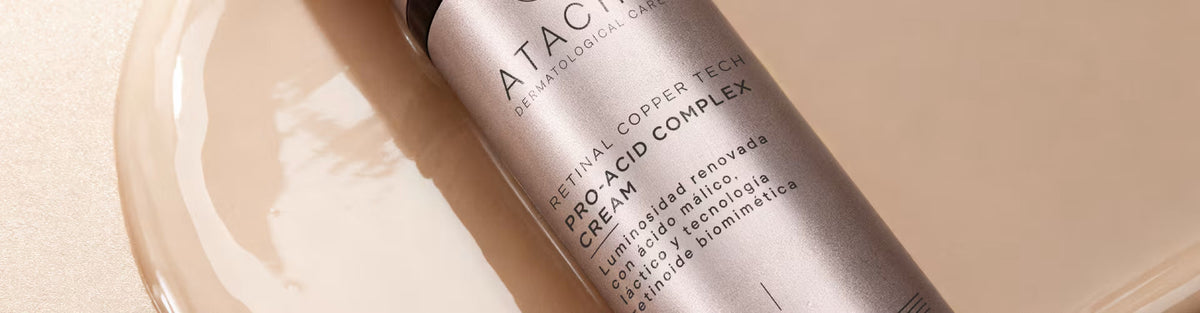
If you’ve been interested in skincare for a while, you’ve surely heard of retinol. But lately, another name is starting to appear more and more: retinal.
Is it the same thing? Is it stronger? Is it better? And why does it seem to be everywhere now?
The answer lies in how cosmetics have evolved in recent years.
First, the basics: what is retinal?
Retinal—also called retinaldehyde—belongs to the retinoid family, vitamin A derivatives widely used in skincare for their ability to improve skin texture, radiance, and the appearance of fine lines.
For a long time, retinal was considered an "expert-only" active ingredient. It was very close, in the skin’s metabolic pathway, to retinoic acid, which made it perceived as especially potent.
Because of this, although it was very interesting from a cosmetic point of view, it wasn't the most common choice in daily-use formulas.
Until now.
Why retinal has become trendy
What has changed isn’t the retinal… but the way it is formulated.
Thanks to new cosmetic technologies—such as liposome encapsulation—it can now be incorporated into formulas that release it onto the skin gradually, rather than all at once.
The result?
A gentler experience, better integration into your routine, and greater compatibility for skin types that previously avoided retinoids.
This has caused retinal to stop being viewed as a "difficult" active ingredient and start taking a leading role in advanced facial care.
So… how is it different from retinol?
Both belong to the same family, but they don’t work exactly the same way within the skin.
- Retinol requires more conversion steps to be utilized by the skin. That is why it is usually introduced gradually and is common in beginner routines.
- Retinal requires fewer internal conversions, which means it acts more directly. For years, this was associated with higher intensity, but today, thanks to new release technologies, it can be formulated for a more balanced experience.
In practice, the difference isn't just "which is more potent," but how the product is designed and what skin type or routine it is intended for.
Which one should you choose for your skin?
Here’s the important part: there is no one-size-fits-all answer.
Retinol is usually a good fit if:
- you are starting out with retinoids
- you are looking for a gradual introduction
- you prefer very gentle routines at the beginning
Retinal can be interesting if:
- you already have experience with retinoids
- you are looking for more optimized action
- your skin needs advanced but well-tolerated formulas
- you have avoided retinoids in the past and want to try again with the latest technologies
Always within a well-planned routine, used at night and with sun protection in the morning.
What has really changed: the way we create cosmetics
The current popularity of retinal reflects something broader: today we aren’t looking for formulas that "clash" with the skin, but products that work with it.
Innovation is no longer just about adding potent active ingredients, but about learning how to dose them better, release them in a controlled way, and make the skin feel comfortable while using them.
That is why retinal has become one of the most interesting retinoids of the moment.
Because in skincare, in the long run, the best routine isn’t the most aggressive one… but the one you can maintain.


